
The Four Big Composite Brands, Compared Honestly
TimberTech, Deckorators, MoistureShield, and Trex — a factory-trained builder's take on what each one actually delivers in North Atlanta's heat and humidity.
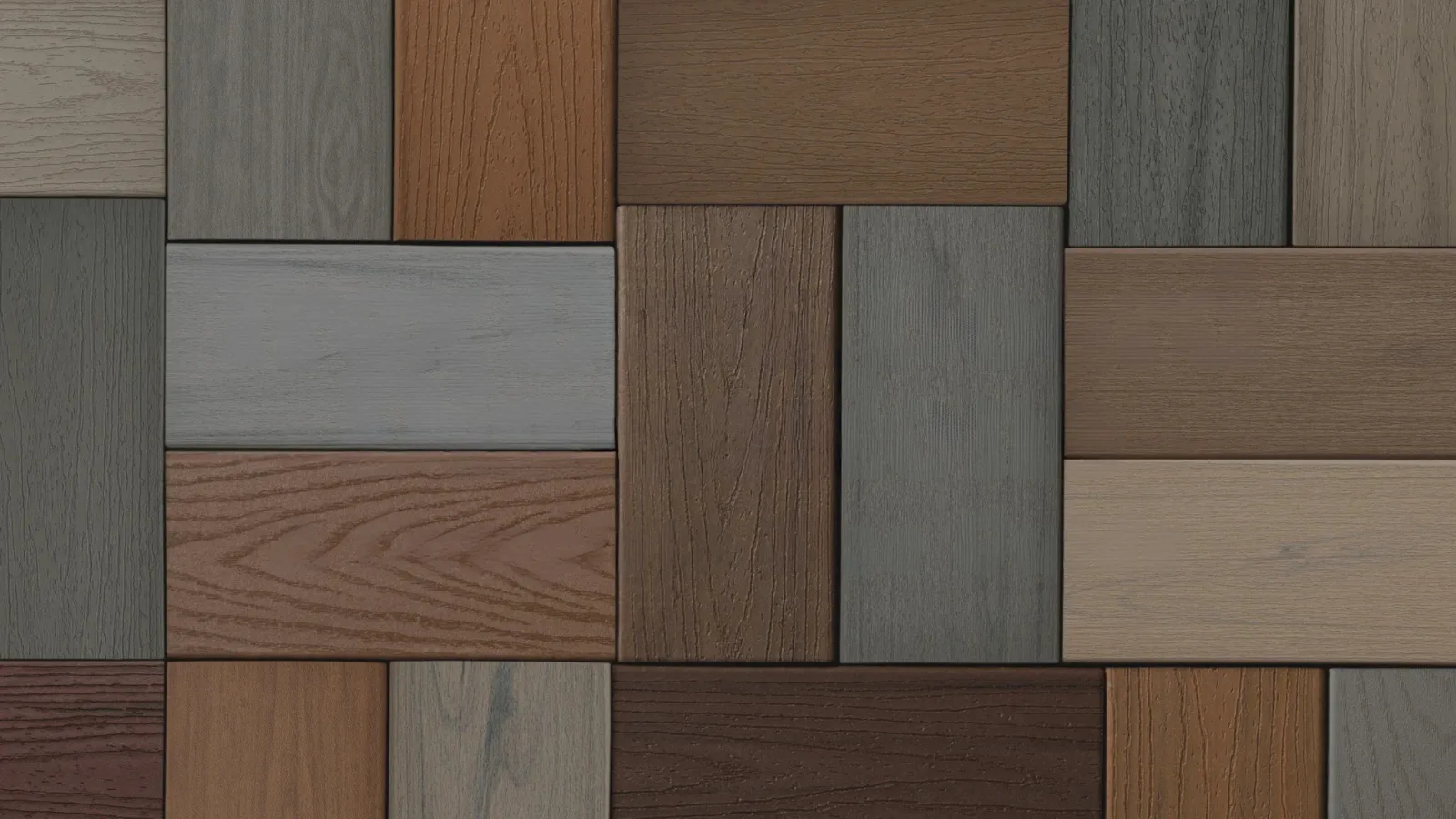
Composite decking board samples — the color and texture range across today's top four brands is wider than most homeowners realize.
First — why composite at all in Georgia?
Because our climate is rough on outdoor materials. Heat and UV fade and degrade. Humidity feeds mold and rot. Pollen and afternoon storms mean constant moisture cycling. A quality capped composite or PVC board shrugs all of that off with a wash now and then. You pay more up front than wood, but you stop paying in sealant, repairs, and replacement — which is where wood quietly becomes the expensive option. (I break that math down in a separate piece on composite vs. wood cost.)
The four brands at a glance
| What matters | TimberTech (AZEK) | Trex | Deckorators | MoistureShield |
|---|---|---|---|---|
| Core technology | Capped composite (PRO/EDGE) and full capped PVC (AZEK) | Capped wood-plastic composite; shell over wood/recycled plastic core | Surestone mineral-based composite | Solid-core composite, capped on all four sides |
| Standout strength | Premium looks & widest color range; PVC line resists moisture best | Brand recognition; good mid-range value; wide availability | Dimensional stability & strength; great slip resistance | Moisture & ground/water contact; heat-reducing option |
| Heat underfoot | Moderate; lighter colors help | Can run warm; dark colors particularly so | Tends to run cooler; lower thermal movement | CoolDeck option reflects heat (cooler surface) |
| Ground / water contact | PVC handles wet well; check line | Not rated for ground contact on most lines | Rated for ground & water contact | Yes — even submerged; its specialty |
| Warranty range* | Up to lifetime + 50-yr fade/stain (AZEK PVC) | Up to 25-yr fade/stain (Transcend line) | Up to 50-yr structural | Up to 50-yr structural + up to 50-yr fade/stain (Vision) |
| Best fit | Premium home, top-tier aesthetics | Budget-conscious or mid-range remodel | Stability-critical or poolside/slip-sensitive builds | Lakeside, low-clearance, or ground-contact builds |
*Warranty terms vary by product line and change over time. Always confirm against the manufacturer's current warranty sheet for the exact board you choose.
TimberTech (AZEK) — the premium benchmark
TimberTech is what I reach for most on higher-end North Atlanta homes, and it's the line I'm factory-trained on. It comes in two families: capped composite (their PRO and EDGE lines) and full capped PVC (the AZEK line). The PVC boards contain no organic material in the cap or core, which means there's essentially nothing for moisture or mold to grab onto — a real advantage in our humidity. The aesthetics are also the best in the category, with the widest range of realistic, multi-tonal colors that read like real hardwood from the deck chair.
- Choose it when: you want the most refined look and the longest premium warranty, and you're building a deck that matches a higher-value home.
- Trade-off: it's typically the priciest of the four, especially the PVC line. You're paying for looks and longevity.
Trex — the household name
Trex is the brand most homeowners have already heard of — it practically invented the category, and that familiarity has real value. Their flagship Transcend line is a solid capped composite with decent color options and a respectable warranty. Where Trex earns its place is in mid-range remodels where budget matters but the homeowner still wants composite's low-maintenance story. It's widely available, contractor familiarity with installation is high, and it delivers reliably on its core promise.
That said, it's worth being clear-eyed about what Trex is and isn't. It uses a wood-based core, which makes it more moisture-susceptible at the edges than a full PVC or solid-core option. Most Trex lines also aren't rated for ground contact. In North Atlanta's humidity, that distinction matters — which is why I tend to spec other brands for elevated, premium, or moisture-adjacent situations.
- Choose it when: budget is a real constraint, the deck is elevated and away from standing moisture, and name-brand familiarity matters to the homeowner or future buyer.
- Trade-off: shorter warranty terms than competitors at the top end, and less suited to moisture-prone or ground-contact situations than MoistureShield or Deckorators.
Deckorators — the engineer's choice
Deckorators' claim to fame is Surestone, a mineral-based composite rather than the usual wood-and-plastic blend. In practice that means two things I care about as a builder: it's dimensionally stable (it barely expands and contracts as temperatures swing, which matters a lot in Georgia's day-to-night and season-to-season range), and it has excellent slip resistance even when wet. It's also rated for ground and water contact. It's strong, stable, and a smart pick around pools.
- Choose it when: you've got a poolside deck, a long run where thermal movement would show, or you simply want maximum structural stability.
- Trade-off: the color and texture range, while good, isn't quite as deep as TimberTech's premium lines.
MoistureShield — built for the wet stuff
MoistureShield earns its name. Its solid-core boards are capped on all four sides and are rated not just for ground contact but for full submersion — which almost no competitor will warrant. That makes it the obvious pick for lakeside builds (think Lake Lanier), docks, and low-clearance decks that sit close to the ground where moisture lingers. Their top Vision line also includes CoolDeck technology, which reflects solar heat and keeps the surface meaningfully cooler underfoot — a genuine benefit on a sun-baked Georgia deck.
- Choose it when: your deck is near water, sits low to the ground, or bakes in full afternoon sun and bare feet are a priority.
- Trade-off: the design range is a touch narrower than TimberTech, though the performance is hard to beat for its niche.
No brand is "the best." The right one depends on your deck.
Any contractor who only ever pushes one brand is selling what's easy for them, not what's right for you. I lean TimberTech for premium aesthetics, MoistureShield for anything near water or low to the ground, Deckorators when stability and slip resistance lead the brief, and Trex when budget drives the conversation and the application is straightforward. The deck tells us the answer.
What about heat? The barefoot question
Everyone asks, so here's the truth: every composite gets warm in direct Georgia sun, and color matters more than brand. A dark board in full afternoon sun will be hot no matter whose name is on it. If barefoot comfort is a priority, two things help far more than brand loyalty — choosing a lighter color, and choosing a heat-reducing technology like MoistureShield's CoolDeck. Smart shade planning (a pergola, an awning, orientation) does the rest.
The mistake that costs more than the brand
Here's what I'd want you to take away more than any brand name: the best board in the world fails on a bad frame. I see it constantly on decks built by the lowest bidder — premium decking screwed down over an undersized, improperly spaced, or under-ventilated substructure. Within a few years there's sag, squeak, fastener pops, and trapped moisture rotting the frame underneath a "lifetime" surface.
Composite decking is only as good as the structure and the installation under it: correct joist spacing for the product, proper ventilation, the right hidden-fastener system, flashing where the deck meets the house, and code-compliant footings and connections. That's the part you're really hiring for — and it's the part the cheap quote skips.
Common questions
Which composite decking is best for North Atlanta's climate?
There's no single best — it depends on the deck. For premium aesthetics and humidity resistance, TimberTech's PVC (AZEK) line is excellent. For lakeside or low-to-the-ground decks, MoistureShield's moisture rating wins. For poolside or stability-critical builds, Deckorators' mineral-based Surestone is a strong choice. Trex Transcend works well for straightforward elevated decks where budget is a factor. Color and proper installation affect real-world performance as much as brand.
How does Trex compare to TimberTech?
Both are solid capped composites, but they target different parts of the market. TimberTech (especially the AZEK PVC line) is the premium choice — better aesthetics, longer warranties, and superior moisture resistance at the core level. Trex is more widely available and tends to be more affordable, making it a reasonable pick for mid-range projects on elevated decks away from standing water. For high-value homes or moisture-adjacent applications, I'd lean TimberTech or MoistureShield over Trex.
Is composite decking worth it over wood in Georgia?
For most homeowners here, yes. Wood requires regular sealing and tends to rot, splinter, and gray quickly in our heat and humidity. Composite costs more up front but eliminates most maintenance and typically lasts far longer, which usually makes it the cheaper option over the life of the deck.
Does composite decking get too hot to walk on?
Any decking gets warm in direct sun, and board color matters more than brand. Lighter colors and heat-reducing technologies (like MoistureShield CoolDeck) stay noticeably cooler. Shade planning helps too.
How long does a composite deck last?
Quality capped composite or PVC decking is generally warranted for decades, and many lines carry warranties up to 50 years or a limited lifetime. Trex Transcend offers up to 25-year fade/stain coverage. Real-world lifespan depends heavily on the quality of the substructure and installation beneath the boards.
Untitled_design__1_.png — rename to something descriptive for production (e.g. composite-decking-samples.jpg) and update the canonical URL to include Trex in the slug if SEO warrants it.Let's build one that lasts — the right way.
I'll help you choose the right product for your space, your sun, and your budget — then my team builds it on a structure that won't let you down. Free in-home consultation.
Call (678) 661-6400